How to start freelance coding and land your first project
For a first paid coding project, choose one job a real person needs to do. A pottery studio with a hard-to-use class schedule gives us an example to follow from the first demo to the $480 final invoice.
Build one example a buyer can try
Suppose a pottery studio publishes its class schedule as a PDF. On a phone, customers have to zoom in, remember a date and go back to find the booking link. A service you could sell is “I turn a class schedule into a mobile page that your staff can update.” You can demonstrate that offer with HTML, CSS and the content tools you already know.

Make a small demo with invented classes. Give a visitor two things to try: find Saturday’s class from a phone and replace a booking link as the studio manager. Include the live demo, a screenshot of the starting point and a short README explaining how updates work. Label it as a sample project. If you keep your work on GitHub, you can pin the sample repository on your profile. Put the demo link first so a studio owner can try it without reading the code.
Find the person who owns the problem
In 2025, self-employed workers held 18% of U.S. web developer jobs, according to the Bureau of Labor Statistics. For your first client, start with businesses whose schedules you already use, people you know who run classes, or a local designer who needs someone to build a page. Look at the public customer journey. Choose one business where your demo solves a specific step, then ask the person who maintains the schedule whether that step costs them time.
“I was looking for your Saturday wheel class on my phone and had to switch between the schedule and the booking page. I built a sample that puts both together. Would this help your students? I’d like to see how you update the schedule before I quote it.”
On the call, ask who updates class dates, where bookings go, who can approve the page and who pays the invoice. If the studio needs live availability from its booking provider, ask for its integration documentation. A paid discovery session can establish feasibility before you promise a fixed price.
Write a quote the client can approve
For this fictional job, the studio will supply six class descriptions and working booking links. The developer will build one mobile schedule page in the existing site, enter the six listings, include one round of wording changes and teach the owner to edit a class. The studio keeps its booking system. A custom availability feed would get a separate quote.
Estimate your own time for setup, build, testing, revisions and handoff. In this example, eight hours at a planning rate of $90 supports a $720 fixed fee. The hours help you decide what to charge. The customer agrees to the $720 price for the listed result. Use your own costs and billable hours to set your rate.
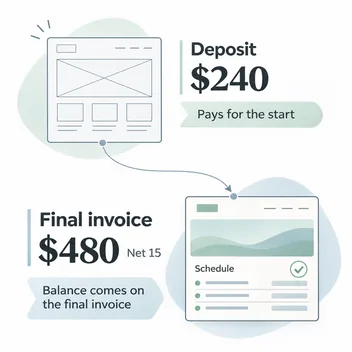
“$720 for the schedule page described above. $240 is due to start. The remaining $480 is due 15 days after the final invoice. Work starts when we receive the deposit, content and site access. Before launch, you’ll check the six booking links on a phone and edit one class yourself.”
Send the scope, timing, acceptance check and payment schedule together. Wait for written approval. If the client later asks for an availability feed, price that addition and get approval before building it. You can adapt a blank estimate for the original scope.
Hand over the page and bill the balance
On the preview site, ask the owner to change one Saturday class and follow the updated booking link. Check each of the other five links. Save the owner’s approval, publish at the agreed time and hand over the editing instructions. Agree who handles future changes and who owns the hosting account.
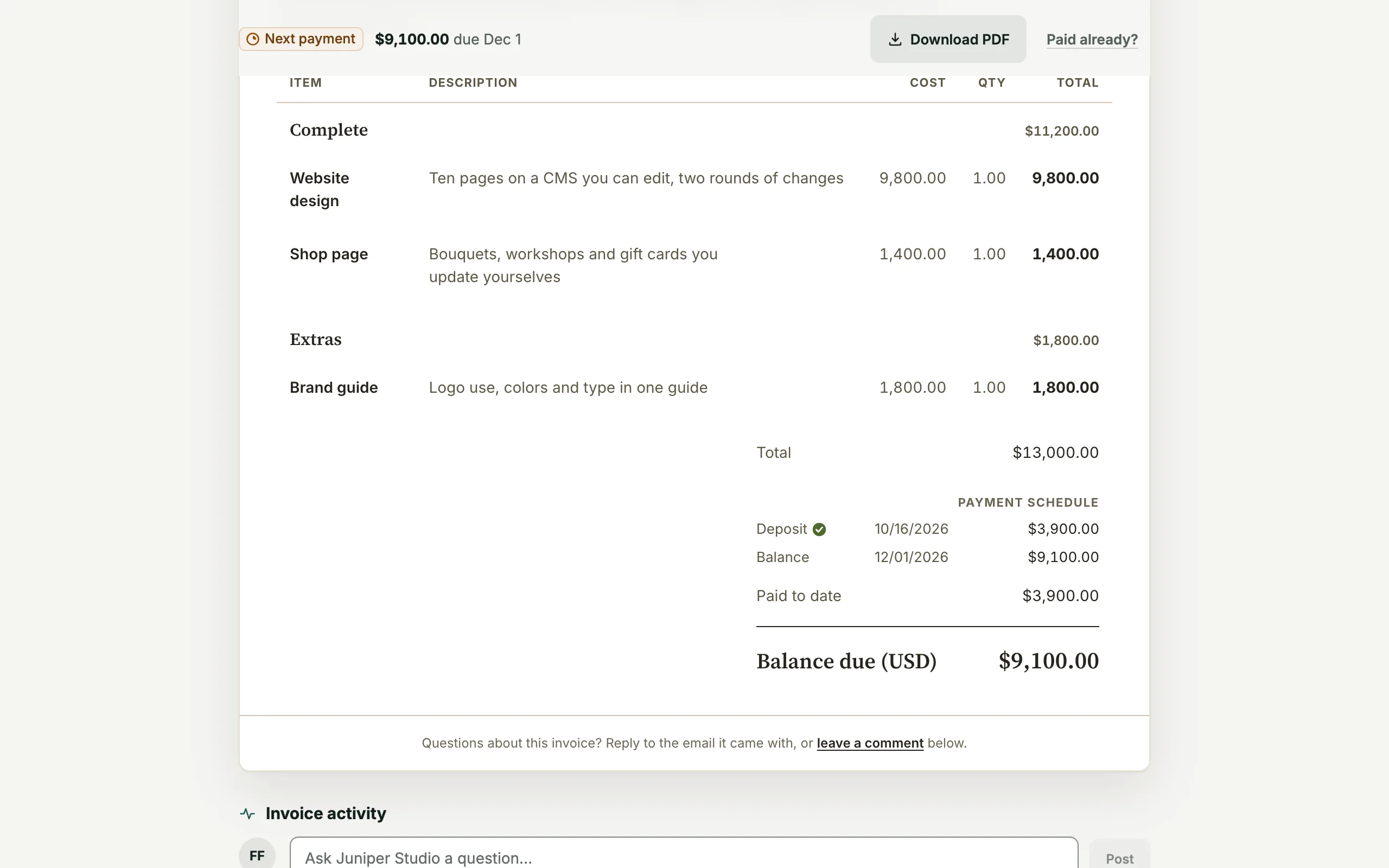
- Class schedule page
- $720
- Deposit received
- $240
- Balance due
- $480
Use the same project name on the quote and the invoice. Show the deposit as received only after it clears. Include the due date and payment instructions. The web design invoice template gives you a starting point. Once the client has tried the finished page, ask permission to show it in your portfolio and describe what changed.