Contractor invoice template: labor, materials, change orders.
Bill for labor, materials and approved changes on one job. Download a blank form, or open the remodeler’s $6,259.50 progress invoice in the generator to edit it and calculate your own totals.
Written by the BillGrid team. Checked .
- Separate
- labor and materials, always
- Numbered
- change orders, with the date signed
- Your license
- number on the invoice; required on contracts in CA
The sample contractor invoice, line by line
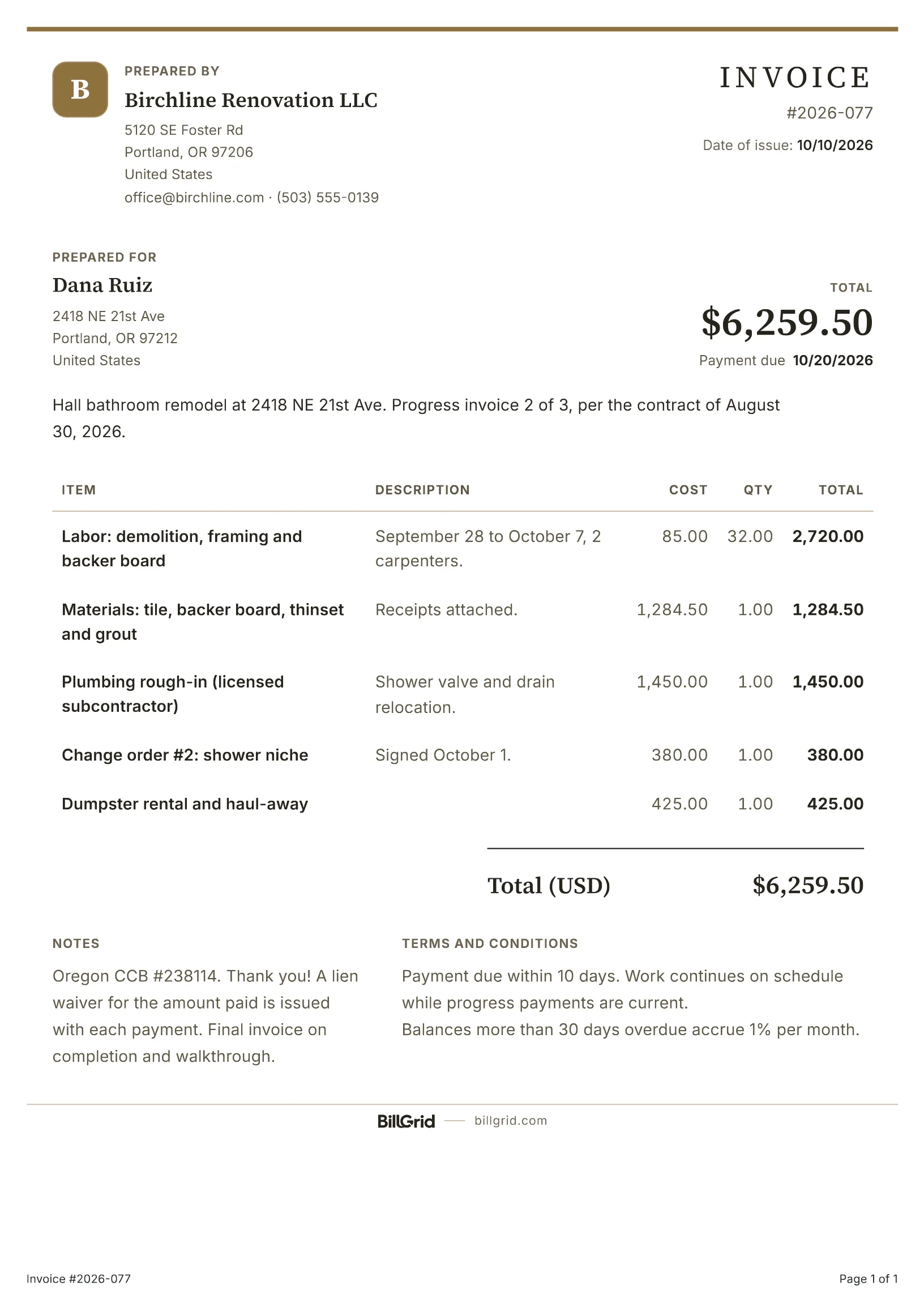
The sample above is a remodeler's second of three progress invoices for a hall bathroom: $6,259.50, due in 10 days. Each line is there for a reason.
| Item | Description | Cost | Qty | Total |
|---|---|---|---|---|
| Labor: demolition, framing and backer board | September 28 to October 7, 2 carpenters. | 85.00 | 32.00 | 2,720.00 |
| Materials: tile, backer board, thinset and grout | Receipts attached. | 1,284.50 | 1.00 | 1,284.50 |
| Plumbing rough-in (licensed subcontractor) | Shower valve and drain relocation. | 1,450.00 | 1.00 | 1,450.00 |
| Change order #2: shower niche | Signed October 1. | 380.00 | 1.00 | 380.00 |
| Dumpster rental and haul-away | 425.00 | 1.00 | 425.00 | |
| Total (USD) | $6,259.50 | |||
| Line | What it tells your client |
|---|---|
| Labor | Hours and crew, with the dates. In time-and-materials work this is the line clients check first. |
| Materials | What you bought for the job, with receipts. Whether you charge sales tax on materials depends on your state and how the contract is written, so mark only the lines that are taxable. |
| Plumbing rough-in (licensed subcontractor) | Work a sub did for you, on its own line, so the client sees who did it and that they're licensed. |
| Change order #2 | Each signed change order on its own numbered line with its date. Never folded into labor. |
| Dumpster rental and haul-away | Equipment, permits and disposal as their own lines: costs of the job, not of your time. |
Time and materials invoice template and daily field ticket
Record the crew’s hours and materials on site. When it’s time to bill, give the client an invoice they can match to the signed ticket.
On site: record the extra work on one ticket
On November 10, two carpenters installed extra wall blocking under written authorization CO-07. Each worked two hours. They entered four labor hours and six boards on ticket TM-014 and attached the lumber receipt.
The site representative signed for the work and quantities observed. The office checked the rates against CO-07. For your own job, use one ticket per work date and enter amounts by hand or in Word.
In the office: turn ticket TM-014 into an invoice
| Invoice line | Quantity × agreed rate | Amount |
|---|---|---|
| Install wall blocking | 4 labor hours × $65 | $260 |
| Framing lumber | 6 boards × $8 | $48 |
| Total for TM-014 before tax or markup | $308 | |
Put the job, ticket number and authorization reference on the invoice so the client can match it to the signed record. If the $308 is included in a progress draw, attach the ticket to that draw and bill it once.
Contractor bill format: what goes on it
A contractor's bill and an invoice are the same document; homeowners tend to say bill. Whatever you call it, it holds these parts, top to bottom.
| Part | What it says |
|---|---|
| Your business | Your name, address, phone and email, and your license number. |
| Invoice number and date | A number you've never used, and the day you send it. Number progress bills in order: "Progress invoice 2 of 3". |
| Bill to | The client's name and billing address, and the job site address when it differs. |
| The job | The project name or job number, and the contract, PO or change order the bill is under. |
| Work done | What was done and the dates or period the bill covers. |
| Labor | Hours times your rate, or the agreed price for this stage of the work. |
| Materials | What you bought for the job, itemized or as one line with the receipts attached. |
| Subs and equipment | Each subcontractor's work, rentals, permits and disposal, each on its own line. |
| Change orders | Each signed change order on its own numbered line. |
| Totals | The subtotal, sales tax where it applies, the deposit or earlier payments taken off, any retainage held, and the amount due. |
| Terms | The due date, how to pay you, the late fee you agreed, and the lien waiver you'll issue with the payment. |
Construction progress billing draw schedule
Download the progress billing draw schedule (Excel). Start with the blank sheet for your job, or follow the completed drywall example from the first draw through the final release of retainage.
For each billing period, enter approved changes, new work earned, the retainage rate on that work and any authorized release. Each sheet covers four draws. For a longer job, carry the closing balances into a new blank sheet.
How much goes on draw 2?
The drywall contractor earned $22,800 on draw 1 and billed $20,520 after retainage. On draw 2 a signed $2,000 change order takes the contract to $52,000. The crew completes another $18,400. That brings earned work to $41,200 and total retainage held to $4,120.
$41,200 earned − $4,120 held − $20,520 previously billed = $16,560 due on draw 2. If the client paid only $20,000 on draw 1, the other $520 stays on that invoice. With draw 2 issued, the two open balances total $17,080.
On the subcontractor invoice below, enter $18,400 of work and deduct $1,840 of current-period retainage. The amount due should match the schedule’s $16,560. For a final release with no new work, enter the authorized amount once as “Release of previously held retainage” and withhold zero.
The example uses 10% retainage. Enter the rate and release terms permitted by your contract and applicable law. If you already billed for stored materials, leave their cost out of new work when you later invoice for installation.
Subcontractor invoice template: what changes
Use this form to bill a general contractor for work completed this period. It has fields for the GC’s accounts payable contact, subcontract or PO number, and any retainage withheld on this bill.
- The client is the general contractor. Bill the GC's company at the address in the subcontract, and put its project name or job number, the subcontract or PO number and the job site at the top. Accounts payable files invoices by job; one without a job number waits.
- You bill against the schedule of values. Each line is a part of your scope with the share done this period. Many commercial GCs want a pay application (often the AIA G702 and G703 forms) with the invoice or instead of it, by a set day each month; the subcontract says which.
- Show the retainage on each draw. Record what you earned, what the general contractor holds under the subcontract and what is due now, as below.
- A lien waiver goes with each payment. Usually a conditional waiver with the pay application and an unconditional one once the money has cleared.
| On a drywall sub's progress bill | Amount |
|---|---|
| Work completed this period: levels 2 and 3 | $18,400.00 |
| Retainage held, 10% | −$1,840.00 |
| Due on this invoice | $16,560.00 |
| Retainage held to date | $4,120.00, available to bill as the contract permits release |
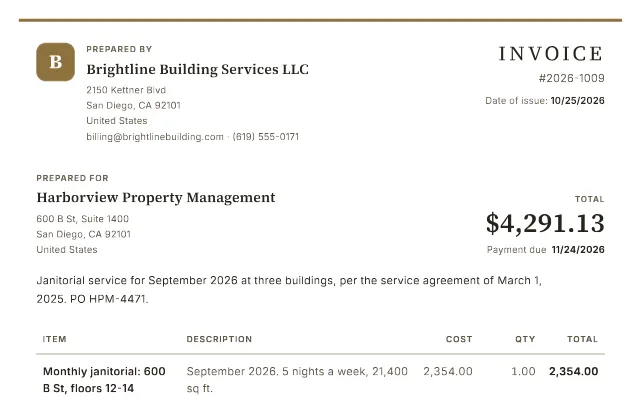
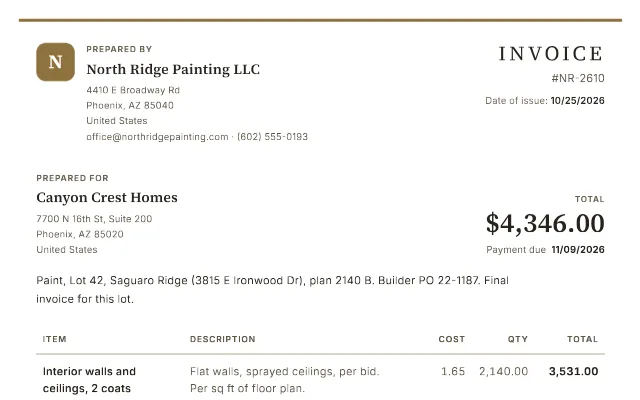
Before the first payment, expect the GC to ask for your W-9 and a certificate of insurance. On federal projects the prime contractor has to pay you within 7 days of being paid for your work; on a private job, check the subcontract for a pay-when-paid clause. The painting invoice template is one sub's invoice to a builder, with the lot and the builder's PO.
Your license number
California requires your CSLB license number on all contracts, bids and advertising, and putting it on every invoice is good practice in any state that licenses contractors. Start the notes with it, as this one does.
Retainage and lien waivers
Record the rate and release condition from your agreement, and check which limits apply to your job. Federal and state rules can differ. If a lien waiver is required, use the form and timing that apply in your jurisdiction. California prescribes forms for progress payments.
General information, not legal or tax advice.
Plumbing service invoice and repair estimate
A kitchen sink shutoff valve leaks. The plumber charges $95 to diagnose it and agrees to credit that fee if the customer approves the repair. Here is the paperwork at each step.
Estimate the repair before approval
The estimate allows $450 for labor and $85 for parts to replace the accessible valve and test for leaks, for $535 before tax. It is valid for 14 days. Update the service address and expiry for your job. If concealed pipe damage changes the scope, get approval for the added work and price before proceeding.
Edit the $535 repair estimate or download the completed estimate (PDF).
Invoice the completed service call
| Invoice line | Amount |
|---|---|
| Diagnostic visit | $95 |
| Valve replacement and leak test | $450 labor |
| Valve and fittings | $85 parts |
| Agreed diagnostic fee credit | −$95 |
| Invoice total before tax | $535 |
Edit the plumbing service invoice. It opens with no payment recorded. If the customer already paid $95 at the visit, enter it once in Paid already. That leaves $440 due. Download the completed invoice showing the payment (PDF).
If the customer declines the repair, bill only the agreed $95 visit. If that visit was already paid in full, the balance is zero.
Wording you can copy
Adapt these examples to your agreement. Agree any late-fee clause before work begins and check applicable limits before using the sample rate.
Payment due within 10 days. Work continues on schedule while progress payments are current. A lien waiver is issued with each payment.
Retainage of [agreed rate]% applies to [eligible work]. The agreed release is due when [release condition] is met.
Balances more than 30 days overdue accrue 1% per month.
Questions
Is a contractor bill the same as an invoice?
Yes. Bill, invoice and progress bill all name the request for payment for work done; what matters is that it has the parts above.
Can I use this as a subcontractor invoice template?
Yes. Put the general contractor as the client, add the job and subcontract numbers to the summary, and show the retainage held on the totals. Check whether the GC also wants its pay application form.
Do I charge sales tax on materials?
It depends on the state and the contract. In many states a contractor on a lump-sum job pays the tax when buying and doesn't charge it; in others the contractor charges it. Check your state's guidance.
How much deposit can a contractor take?
In California, for home improvement, at most $1,000 or 10% of the contract price, whichever is less. Other states have their own rules.
What is a running bill or RA bill?
A running account (RA) bill records work measured to date. Deduct earlier amounts billed or certified under the contract to find the new draw. Track any unpaid balance on the earlier bill separately.
Can I get it as a Word file?
Choose Word for a blank editable invoice, or download the completed Word sample to see the line items. Enter totals yourself in the Word and fillable PDF forms. The online generator calculates them for you.
What's the difference between an estimate and an invoice?
The estimate is the price you propose before the work; the invoice asks for payment for work done. Use the estimate template to quote the job.
Sources: AIA Contract Documents: completing a payment application · CSLB: license number on contracts and ads · CSLB: payment rules · Sales Tax Institute: construction · FAR 32.103: retainage on federal construction · 31 U.S.C. 3905: paying subcontractors on federal work · California Civil Code 8132: progress lien waiver
General information, not legal or tax advice: agree any late fee with your client before the work, and note that some states limit interest.